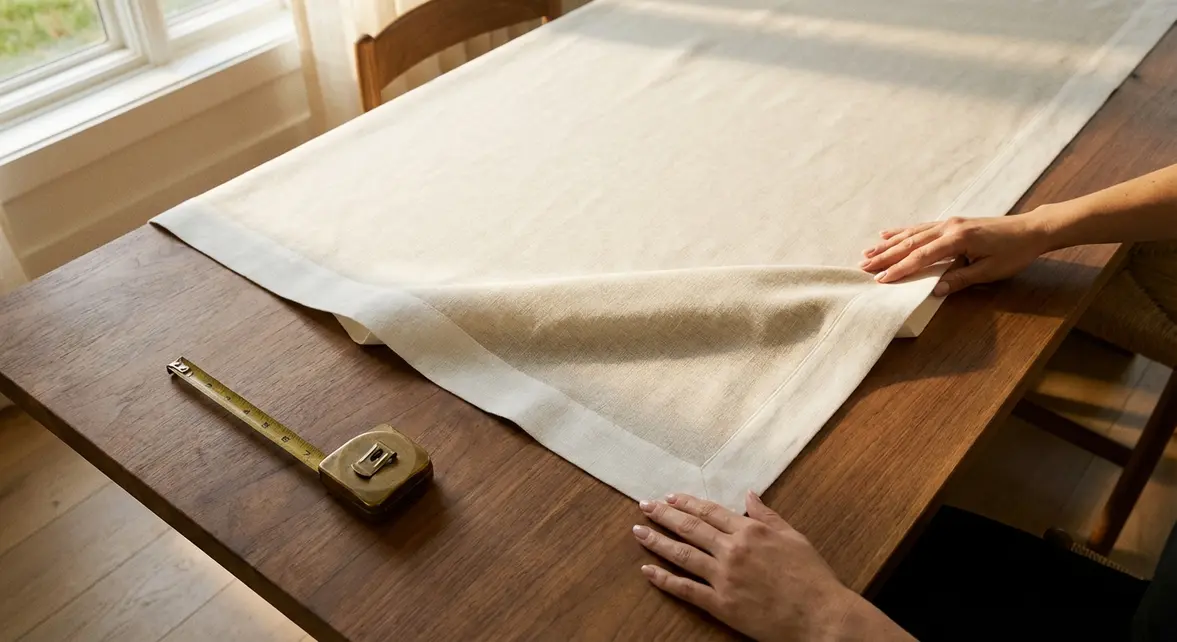
Few things disrupt the harmony of a beautifully appointed dining room like ill-fitting linens. Whether you are hosting a festive holiday dinner or a quiet Tuesday meal, this tablecloth size guide is designed to help you avoid the common pitfalls of fabric that is either awkwardly short or hazardously long.
A tablecloth acts as the canvas for your culinary experience, setting the tone before the first plate is even served. Yet, many homeowners find themselves frustrated by the "Goldilocks" dilemma of off-the-rack options. Buying a standard cloth often results in corners that bunch up on the floor or sides that barely cover the table's edge. While standard sizes exist, a truly refined table requires precision. In this guide, we will demystify the process of measuring, calculating, and selecting the perfect size—and explain how Tabletops By Nomi’s custom cuts can ensure a flawless, bespoke fit for any table shape.
Key Takeaways:
- Measure the furniture, not the fabric: Always start with the exact dimensions of your table surface.
- The "Drop" dictates the style: A 6–8 inch drop is casual; a 10–12 inch drop creates formal elegance.
- Do the math: Add twice the desired drop length to your table's length and width to find your ideal size.
- Consider material stability: Natural fibers shrink, whereas high-quality polyester retains its size and shape wash after wash.
In this article:
- Step 1: The Foundation – Taking Accurate Tablecloth Measurements
- Step 2: Understanding the "Drop" (The Tablecloth Length Guide)
- Step 3: The Calculation – What Size Tablecloth Do I Need?
- Step 4: Navigating Standard vs. Custom Fits
- Step 5: Material and Care Considerations
- In Summary
- Frequently Asked Questions
Step 1: The Foundation – Taking Accurate Tablecloth Measurements#

You cannot confidently choose a fabric or a style until you know the exact dimensions of the furniture underneath it. Many hosts make the mistake of measuring their old tablecloths, assuming the previous size was correct. However, fabrics can stretch or shrink over time, and previous purchases may not have been the ideal fit to begin with.
To get a truly elegant look, you must start with precise tablecloth measurements of the table surface itself. We recommend using a retractable metal tape measure rather than a soft sewing tape, as the metal tape is less likely to bend or sag, ensuring a more accurate reading.
How to measure by shape#
- Rectangles and Squares: Measure the Length (the longest side) and the Width (the shortest side). Be sure to measure straight across the center of the table rather than along the edges, which might be beveled or curved.
- Round Tables: Measure the Diameter. This is the straight line passing directly through the center of the table from one edge to the other.
- Ovals: Measure the longest point (length) and the widest point (width).
- Extensions and Leaves: If you typically use your table with leaves inserted for large gatherings, ensure you measure the table with the extensions in place. If you use the table both ways, you may need two separate tablecloths to accommodate the different sizes.
Hosting hack: If you are unsure if your round table is perfectly circular, measure the diameter in two distinct directions (forming an 'X'). If the numbers differ, your table is technically an oval, and you should use the oval measurement guidelines.
Step 2: Understanding the "Drop" (The Tablecloth Length Guide)#
Once you have your table's dimensions, the next step is stylistic. The "drop" refers to the length of fabric that hangs over the edge of the table and drapes down toward the floor. This single factor determines the formality of your event.
A comprehensive tablecloth length guide generally categorizes the drop into three distinct styles: casual, formal, and banquet.
Casual / Everyday (The "Lap" Length)#
For daily meals, breakfast nooks, or casual lunches, we recommend a drop of 6–8 inches.
- Why it works: This length allows the fabric to hang just above the lap of a seated guest. It is highly practical because it won't bunch up on guests' legs, making it easy to get in and out of chairs.
- Visual impact: It looks neat, tidy, and intentional without feeling stuffy.
Formal / Elegant#
For dinner parties, holidays, and evening entertaining, a drop of 10–12 inches (up to 15 inches) is ideal.
- Why it works: The longer fabric softens the edges of the table and hides the "apron" (the structural wood frame under the tabletop). It adds a sense of weight and luxury to the room.
- Visual impact: This creates a sophisticated silhouette that suggests a special occasion.
Banquet / Ultra-Formal (Floor Length)#
Standard dining tables are roughly 30 inches high. For a floor-length look—common at weddings, galas, or buffet stations—the drop should be approximately 29–30 inches.
- Why it works: This covers the table legs entirely, creating a solid block of color or texture.
- Puddling: Some hosts prefer the fabric to pool slightly on the floor for a romantic, abundant look. To achieve this, the drop would need to exceed 30 inches.
Pro tip: For families with young children or pets, a shorter drop (6–8 inches) is safer, as there is less extra fabric for little hands or paws to pull on.
Step 3: The Calculation – What Size Tablecloth Do I Need?#
Now that you have your table measurements and your desired drop, you can do the math. This is the step where many people get confused, asking themselves, "what size tablecloth do I need?"
The formula is simple: you must add the drop length to both sides of the table.
The Fail-Safe Formulas#
For Rectangular or Square Tables:
- Tablecloth Length = Table Length + (Drop Length x 2)
- Tablecloth Width = Table Width + (Drop Length x 2)
For Round Tables:
- Tablecloth Diameter = Table Diameter + (Drop Length x 2)
A Practical Example#
Let’s walk through a scenario for a standard 6-foot rectangular dining table.
- Table Dimensions: 72 inches long x 30 inches wide.
- Desired Look: Formal dinner party (10-inch drop).
The Calculation:
- Length: 72 inches + (10 inches x 2) = 92 inches.
- Width: 30 inches + (10 inches x 2) = 50 inches.
In this scenario, you would need a tablecloth that measures 50" x 92".
Did you know? Using the correct math prevents the "short side" syndrome, where a tablecloth fits the length perfectly but leaves the width of the table exposed or barely covered.
Step 4: Navigating Standard vs. Custom Fits#
Armed with your ideal dimensions, you may head to a department store only to find that your calculated numbers don't match the packaging. This is the struggle of dealing with standard tablecloth sizes. Retailers mass-produce linens to fit "average" tables, but furniture design varies wildly, leaving many hosts with imperfect compromises.
Common Standard Sizes and Their Limitations#
Here is how retail sizing typically breaks down and why it might not work for you:
- Round Tablecloths:
- 90" Round: On a standard 48" round table, this gives a 21" drop—too long for casual dining but too short for floor length.
- 108" or 120" Round: These are designed for larger tables or floor-length coverage, often overwhelming smaller kitchen tables.
- Rectangular Tablecloths:
- 60" x 120": This is a very common size, but often too narrow for modern, wider dining tables, resulting in a scanty drop on the sides.
- 90" x 132": This is generally a floor-length size for a standard 6-foot table. If you put this on a table for a casual dinner, the fabric will pile up in guests' laps.
- Square Tablecloths:
- 70" x 70" or 90" x 90": These squares work for specific tables but fail when used as overlays on rectangular tables unless the proportions are exact.
The Issue with "Making Do"#
When your calculated size falls between two tablecloth sizes, conventional wisdom suggests you "size up." While this ensures coverage, it often looks messy. A drop that is 4 inches too long can interfere with chairs sliding in, while a drop that is too short exposes the under-structure of the table, ruining the illusion of elegance.
The Tabletops By Nomi Advantage#
This is why custom sizing is the ultimate hosting hack. At Tabletops By Nomi, we believe you shouldn't have to adjust your style to fit a factory mold. Because our products are made-to-order, you input your exact measurements, and we create the cut. Whether you have an antique heirloom with unusual dimensions or a modern custom-built table, a bespoke tablecloth eliminates the need to compromise.
Step 5: Material and Care Considerations#
While size is the primary focus of this guide, the fabric you choose plays a critical role in how that size behaves over time. Not all tablecloth sizes stay the same after the first wash.
The Shrinkage Factor#
Natural fibers like 100% cotton or linen are beautiful, but they are prone to shrinkage. It is not uncommon for a cotton tablecloth to lose 1–2 inches in length and width after a cycle in the washing machine and dryer. If you are buying natural fibers, you must account for this buffer in your initial calculations.
The Polyester Advantage#
Tabletops By Nomi specializes in high-quality spun polyester for a specific reason: stability. Our fabric is designed to mimic the heavy, luxurious drape and soft hand-feel of linen, but it holds its shape perfectly.
- No Shrinkage: The size you calculate is the size that stays, wash after wash.
- Machine Washable: You can host messy spaghetti dinners without fear.
- Wrinkle Resistance: Unlike linen, which requires laborious ironing to look correct (and maintain its full width), our fabrics come out of the dryer ready for the table.
Care tip: Always check the care label before washing. Even stable fabrics last longer when washed with cool water and dried on low heat.
In Summary#
Achieving the perfect table setting is a blend of art and math. By following these steps, you ensure that your dining room looks polished and inviting for every occasion.
- Measure First: Ignore the size of your old linens; measure the table surface length and width (or diameter).
- Decide the Drop: Choose 6–8 inches for casual vibes or 10–12 inches for formal elegance.
- Calculate: Add the drop x 2 to your table dimensions.
- Choose Custom: Avoid the frustration of standard tablecloth sizes by opting for a made-to-order fit that respects your specific furniture dimensions.
Sources
Frequently Asked Questions
Enjoyed this article?
Sign up to receive styling tips, new collections, and exclusive offers.